
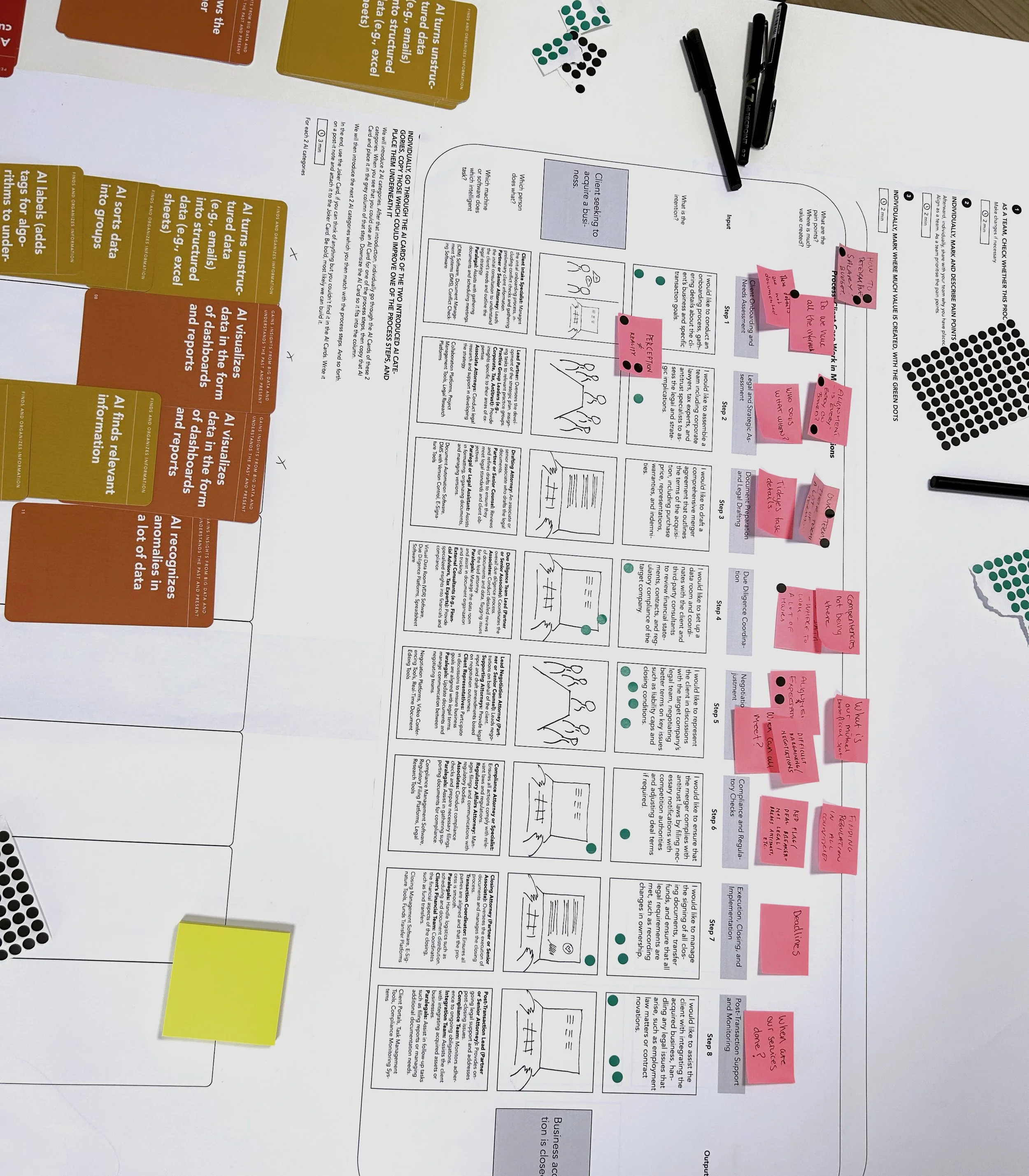
Identify AI opportunities, and develop specific AI solution concepts as a team. No technical expertise needed
Upcoming Bootcamp
4.-7. Jan 2027, 9-13.00 (CEST)
What is process automation?
AI-powered process automation doesn't just make businesses more efficient — it transforms how they operate entirely. From speed and accuracy to predictive capabilities and scalability, the potential gains are significant.


The challenge
Most organizations know AI matters — but don't know where to start. Identifying the right use case, aligning business and technical teams, and ensuring people actually adopt the solution are all significant hurdles. And for consultants, getting a non-technical client from "we should do something with AI" to a concrete project is a challenge in itself.
Who is this for?
Business professionals who want to identify where AI can add value and work effectively with technical teams.
Technical professionals who want to collaborate with non-technical stakeholders on AI initiatives.
External consultants who want to start AI projects with non-technical clients.
Anyone curious about applying AI in their work.
Why AI Design Sprint®: Process Automation?
Combines top-down and bottom-up
Leadership sets the strategic focus in the AI Opportunity Mapping and Framing sessions. The people who actually work with those processes then develop a detailed AI solution together with IT and a decision-maker in the Concept Development & Assessment session. Both parties bring their expertise — and the result reflects both strategic priorities and operational reality.
Enables anyone to develop AI concepts — no technical expertise needed
The AI Cards® put every AI capability into plain language, organised by category and written from the user perspective. This allows participants to match AI capabilities to their work processes and develop concrete concepts independently — no AI expert required. And because the AI Cards® focus on capabilities rather than specific tools, they stay relevant even as the AI landscape keeps shifting.
Brings business and technical teams together
Business people often know where value lies but lack AI knowledge. Technical teams understand AI but struggle to see the business case. The AI Cards® give business people enough AI literacy to identify where it delivers value — and the Collaboration Canvas guides both groups through developing and defining AI solutions together. Each side contributes what they do best.
Considers all AI capabilities, not just a handful of use cases
Most approaches start with a limited selection — a few industry use cases, a handful of AI tools. That constrains the solution before you've even begun. The AI Design Sprint®: Process Automation puts the full landscape of AI capabilities on the table, so the team can identify the best possible solution for their specific situation.
A structured process that makes complexity manageable
AI can feel overwhelming — especially with new developments happening constantly. The Collaboration Board breaks the process into focused 5-minute tasks, so participants only ever need to think about the next small step. Each task is designed for the full team: everyone is heard, decisions are made quickly, and the group moves forward without lengthy discussions. People feel safe, in control, and see progress fast.
How it works
The outcome
Your next AI project. Out of many possible use cases, you've identified the one with the most value.
A solution your team owns. The people who work with the process every day developed it themselves, in their own terms.
Business and IT aligned. Value and feasibility were assessed together, so everyone agrees on what to build and why.
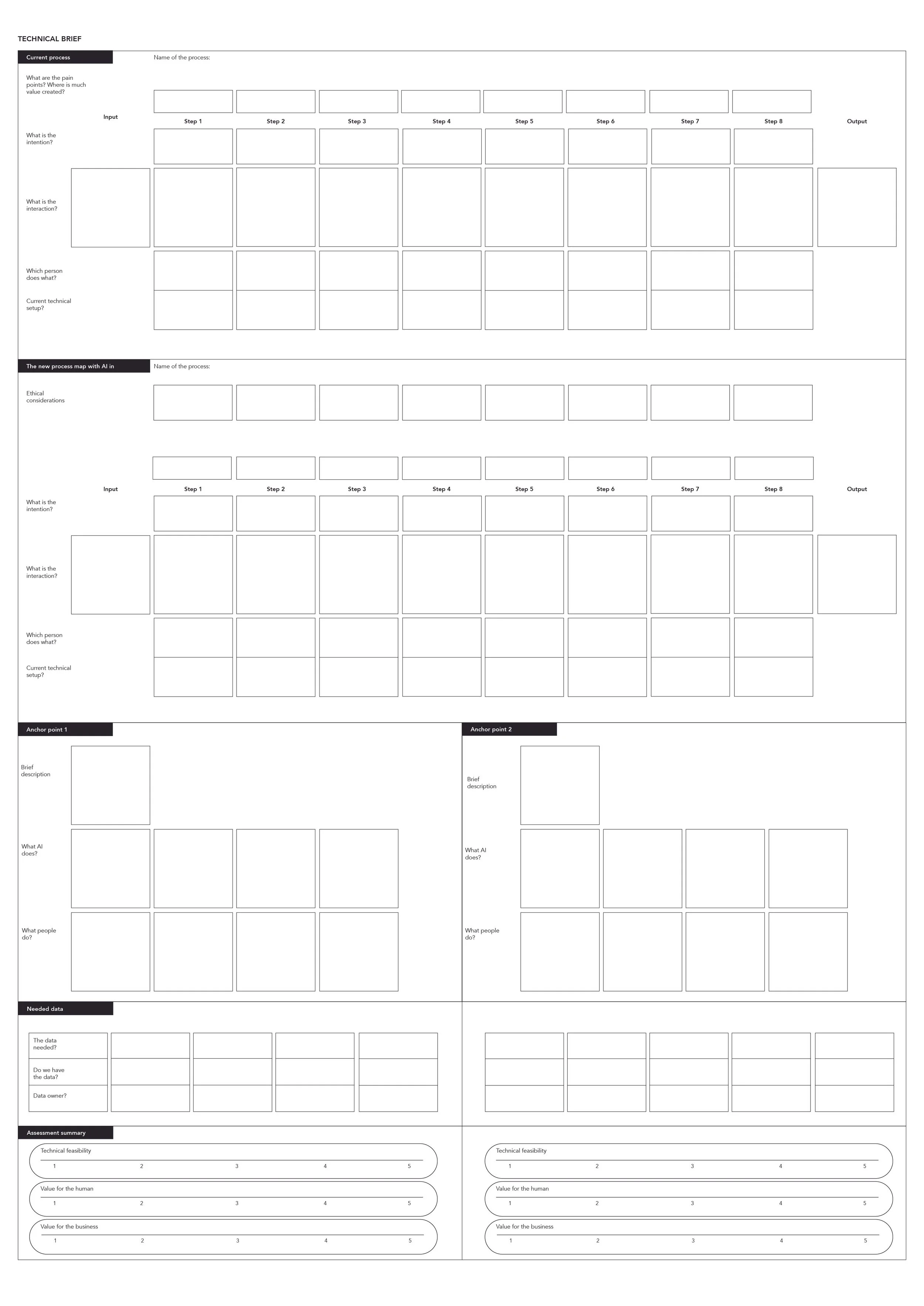
A technical brief. It covers the current work process and the tools in use, the proposed AI solution as a new process map, and the required data with its data owners. It's ready for Tech Check and development.
Where do you start?
Starting point 1 — You know AI matters, but don't know where to begin
This is the most common situation. A head of department or organization sees the potential of AI but feels overwhelmed by the options and doesn't know which process to tackle first. In this case, we begin with an Opportunity Mapping session to identify the most valuable area to focus on — before moving into Concept Development & Assessment.
Starting point 2 — You already have a process in mind
If the team has already identified a specific work process they want to improve with AI, we can map that process immediately and move straight into the Concept Development & Assessment session.
The AI Cards®
The AI Cards® organize every AI capability into categories, each written from the user perspective. Parent cards describe a category of AI capability; child cards break down specific capabilities within it. On the back of each card, a brief description and three use cases bring the capability to life. Available in physical form for onsite sessions and digitally for remote delivery.

The Collaboration Board
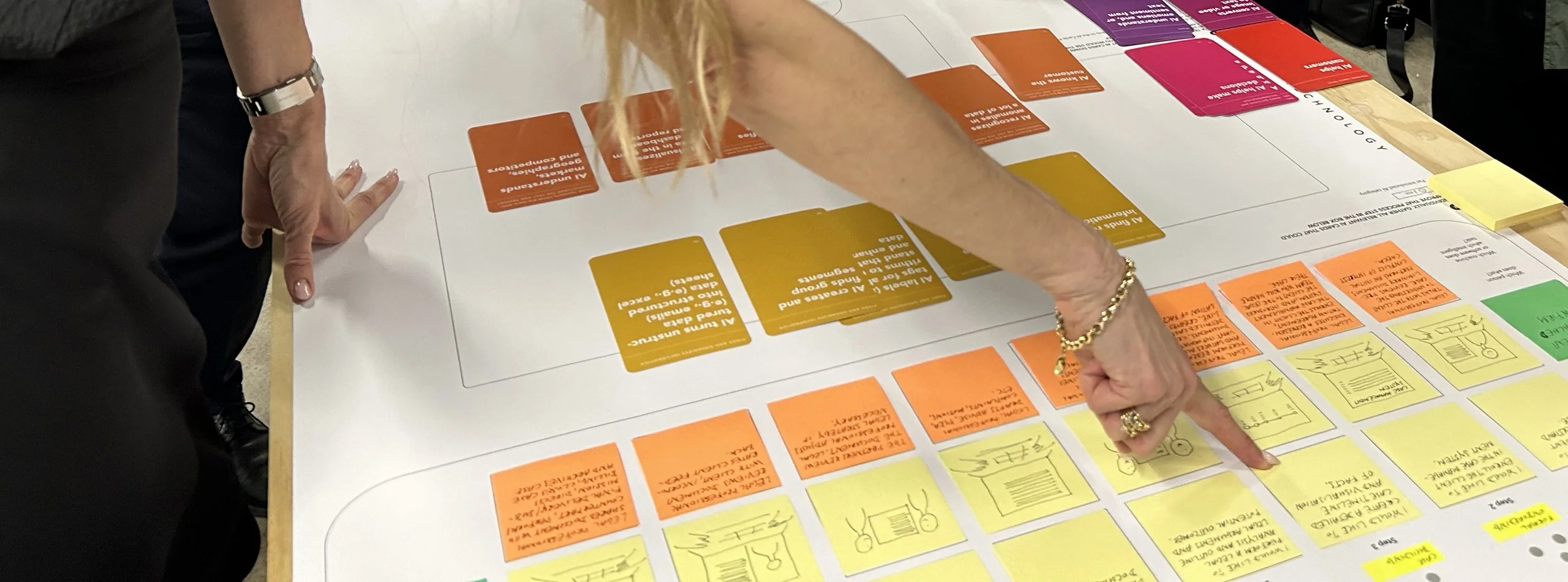
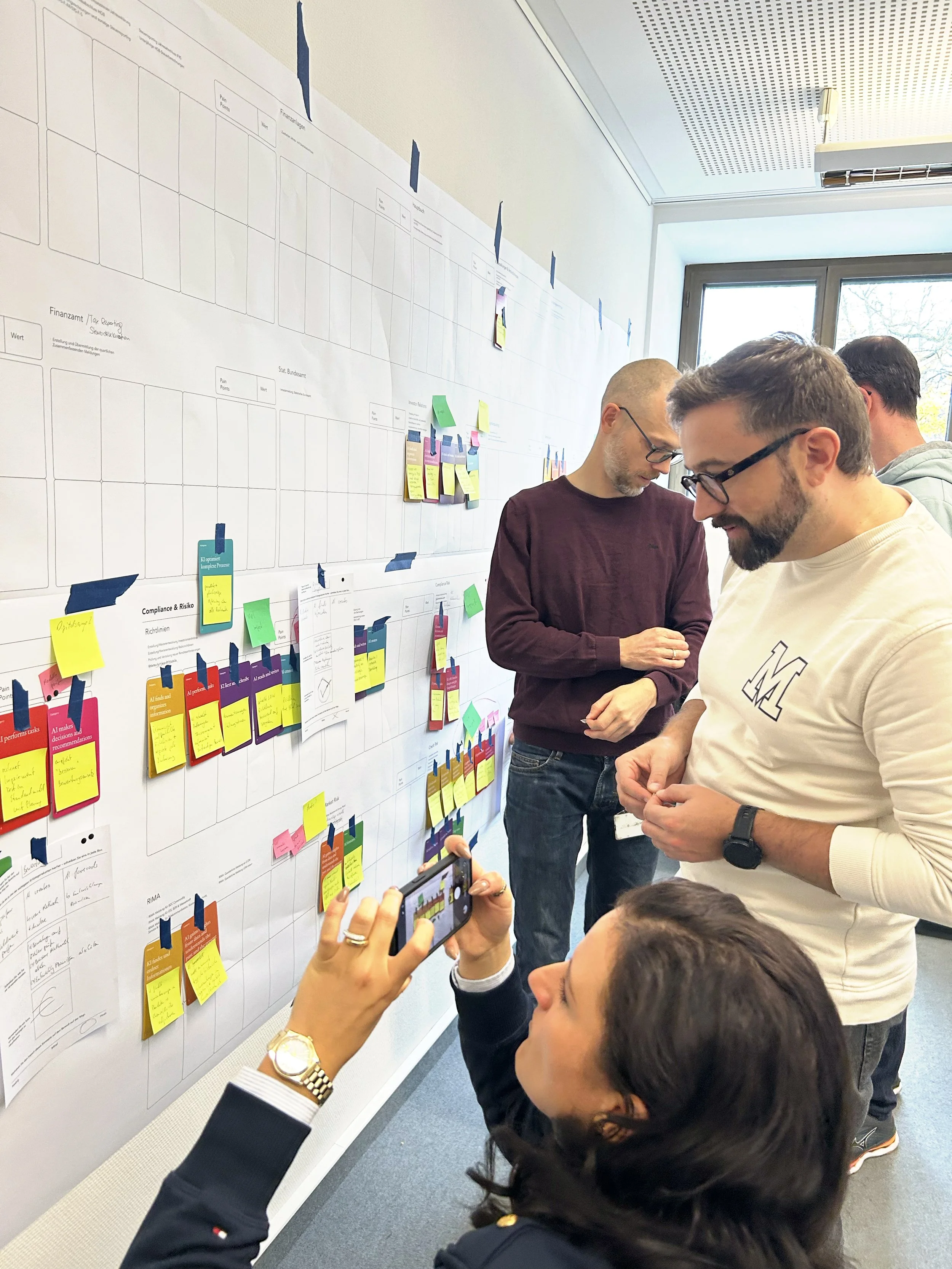
If the AI Cards® are the content, the Collaboration Board is the game board. It is the central worksheet that holds the entire process together — containing the 5-minute tasks, the process map, and clearly defined fields for where to place AI Cards®, Ethical Risk Mitigation Cards, Data Sources Cards, and Resources & Roles Cards at different stages. It tells participants exactly what to do, with which cards, and where — so the team always knows their next move.
For onsite sessions, the Collaboration Board consists of approximately ten A0 format sheets. For remote sessions, it becomes a fully prepared Miro board. At the end of the process, all outputs are consolidated into a technical brief — the concrete deliverable the team walks away with.

Practicalities
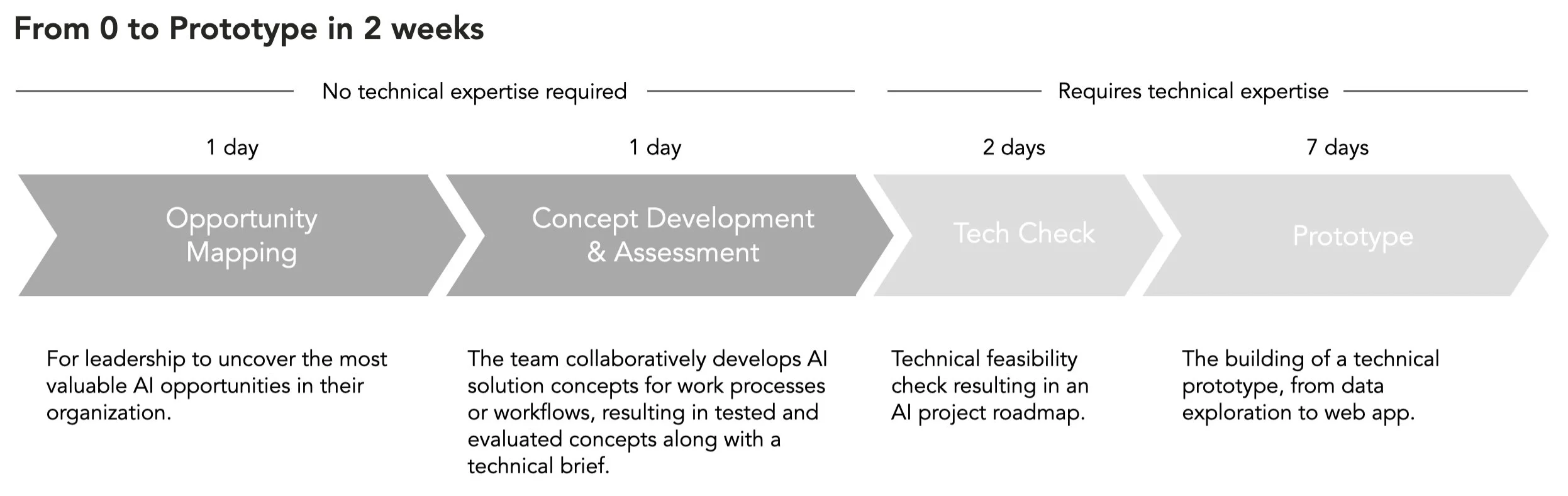
Duration Opportunity Mapping and Concept Development & Assessment each take 1 day plus preparation time. A technical person spends 2 days on the Tech Check and 7 days building the Prototype.
Participants Opportunity Mapping brings together up to 6 people depending on the scope. For a large business area, this typically includes the leadership of that area, the Head of Digitalisation, and someone from IT. For a department-level perspective, the department lead and an IT representative are the core participants.
Concept Development & Assessment involves up to 6 people per process — the people who work with that process daily, the process owner, a decision-maker, someone from IT, and other key stakeholders.
Format Sessions are facilitated by 2 trained and certified AI Design Sprint®: Process Automation facilitators by 33A and can be delivered onsite or remotely.
Input & Output
Opportunity Mapping Input: A mapped department, business area, value stream, or org chart. Output: The identified focus area and process for Concept Development & Assessment.
Concept Development & Assessment Input: A process map of the current state of the process. Output: A technical brief which serves as the handover document — either to the 33A technical team for Tech Check and Prototype, or to your own internal or external technical team if you have been trained and certified in the method by 33A.
Language Currently available in English and German, with additional languages planned.
Facilitators

Michael Brandt
CEO, Co-founder

Kerstin Bognar
Facilitation
Or two other facilitators from 33A.
Presenting ‘Tech Check’ and ‘Prototype’

Joanna Stoffregen
AI Product Development

Erik Stoffregen
AI Product Development
How to get started
There are two ways to work with us.
We run the sprint with you. 33A facilitates the AI Design Sprint®: Process Automation with your team — identifying your AI use case and developing a detailed concept ready for technical development.
Get trained and certified. Become an AI Design Sprint®: Process Automation Facilitator — so you can run sprints independently with your clients or in-house teams. Join as a team in our Company Team Training or individually in one of our upcoming Bootcamps.
FAQ
-
Below we state one example of an AI solution as result from the sprint.
-
Both are built into the process. During the sprint, the team works through the Ethical Risk Mitigation Cards to identify and address potential risks early. The AI expert then examines compliance and data security in detail during the Tech Check — ensuring the proposed solution is both technically feasible and responsible.
-
Adoption is built into the methodology from the start. The people who participate in the Concept Development & Assessment session are the same people who work with that process every day — the future users of the AI solution. Because they develop the concept themselves, they have ownership of it from day one. This makes adoption far more likely than with solutions designed by an external team and handed down.
-
The Tech Check happens early enough that the exposure is limited — at most one day of the team's time and two days of an AI expert. In practice though, a negative Tech Check rarely means starting over. The concept can often be re-scoped to work within technical constraints, or the team can focus on a second anchor point of the overall concept. Either way, the process is designed to keep moving forward.
What others are saying
“It was a truly brilliant training for our team! I was already very impressed with your approach beforehand, and I am even more so after participating in the training. The AI Design Sprint® offers an excellent opportunity to bring business colleagues and technical experts together to speak the same language when it comes to AI. It transforms challenges into specific, detailed solutions, and prioritizes impact over innovation for its own sake. This approach is perfect for us for driving AI adoption throughout our large organization.”
Ivo Strohhammer, Enterprise Architect, SI IT Innovation Lead, Siemens
“The AI Design Sprint®: Process Automation provided a clear structure and guiding thread, while leaving enough space for the team to actively contribute. Each phase built naturally on the previous, turning step-by-step insights into a transparent, clearly defined AI-powered workflow and use case ready for implementation.”
Session participant, IT-Support C-TIA Digital Workplace, EnBW
“I appreciate the practical framework that is tailored to help business leaders unlock the potential of AI using the innovative concept of AI Cards®.”
David Sales, Principal Adoption and Change Management Consultant, Microsoft
“The AI Design Sprint® is such a relevant and genius tool to bridge business and AI thinking.”
Cecilie Bonde Christiansen, Principal Transformation Manager, Amsterdam Data Collective
“Today, the AI Design Sprint® framework is central to how I drive AI ideation and concept development in my division.”
Jacqueline Berger, Cyber Defense Center Analyst, Raiffeisen Bank International
“The combination of top-down and bottom-up approaches is what makes the AI Design Sprint® so brilliant!”
Top-down means starting from business strategy; bottom-up means starting from real user needs.
Christian Tegge, Innovation Expert, E.DIS
AI Design Sprint®: Process Automation Use Case
“We started with the AI Design Sprint®, the MVP phase is completed, and we are currently implementing it.
AI solution: The system intelligently analyzes construction documents, identifies relevant content, and automatically links it to the appropriate assets in our database—enabling a more efficient maintenance process.”

Thomas Harms
Innovation Manager, E.DIS