
AI Design Sprint®
Find out what AI should do for you — then pick the tool
Our training and certification program gives you the skills to guide any team — from recognising where AI can transform their work to developing detailed, actionable AI solution concepts ready for technical development.
Find out what AI should do for you — then pick the tool
AI tools are evolving faster than any organization can track. Chasing the latest tool creates exactly that — a constant chase, and a permanent feeling of being behind.
We suggest a different starting point: find out what AI should do for you. Where does it create the most business value — for your team, your department, your organization? Once you know that, the tool choice becomes clear. Sometimes it's a ready-made solution. Sometimes a low- or no-code tool. And sometimes, the right answer is a customized AI solution built for your specific situation.
Start with the right question. The right tool follows.
When people shape it, they own it
The people who perform a process daily know things no outsider ever will. Developing an AI solution without them and then pushing it into a department is a recipe for resistance — and a solution that misses critical nuance.
Involving future users in shaping the solution does two things at once: it produces a better solution, and it creates the buy-in needed for people to actually adopt it. When people help build it, they own it.
But co-creation works best when it combines two directions. Leadership sets the focus areas — top-down direction that aligns AI initiatives with organizational priorities and unlocks budget. The people on the ground bring the process knowledge and develop the detailed solution — bottom-up depth that makes it real and workable.
Together, that's how AI solutions get built, adopted, and sustained.
Consider all AI, not just a selection of use cases
Most approaches to identifying AI use cases start too narrow. A consultant presents a shortlist. A department browses industry examples. Employees list what they already know. An AI team proposes options for business people to prioritize — without a clear framework for how.
Every one of these approaches has the same flaw: the solution space is already limited before the real thinking begins. You can only choose from what's on the list. And what's not on the list stays invisible.
The alternative is to consider all AI capabilities — systematically, and from the perspective of the people doing the work.
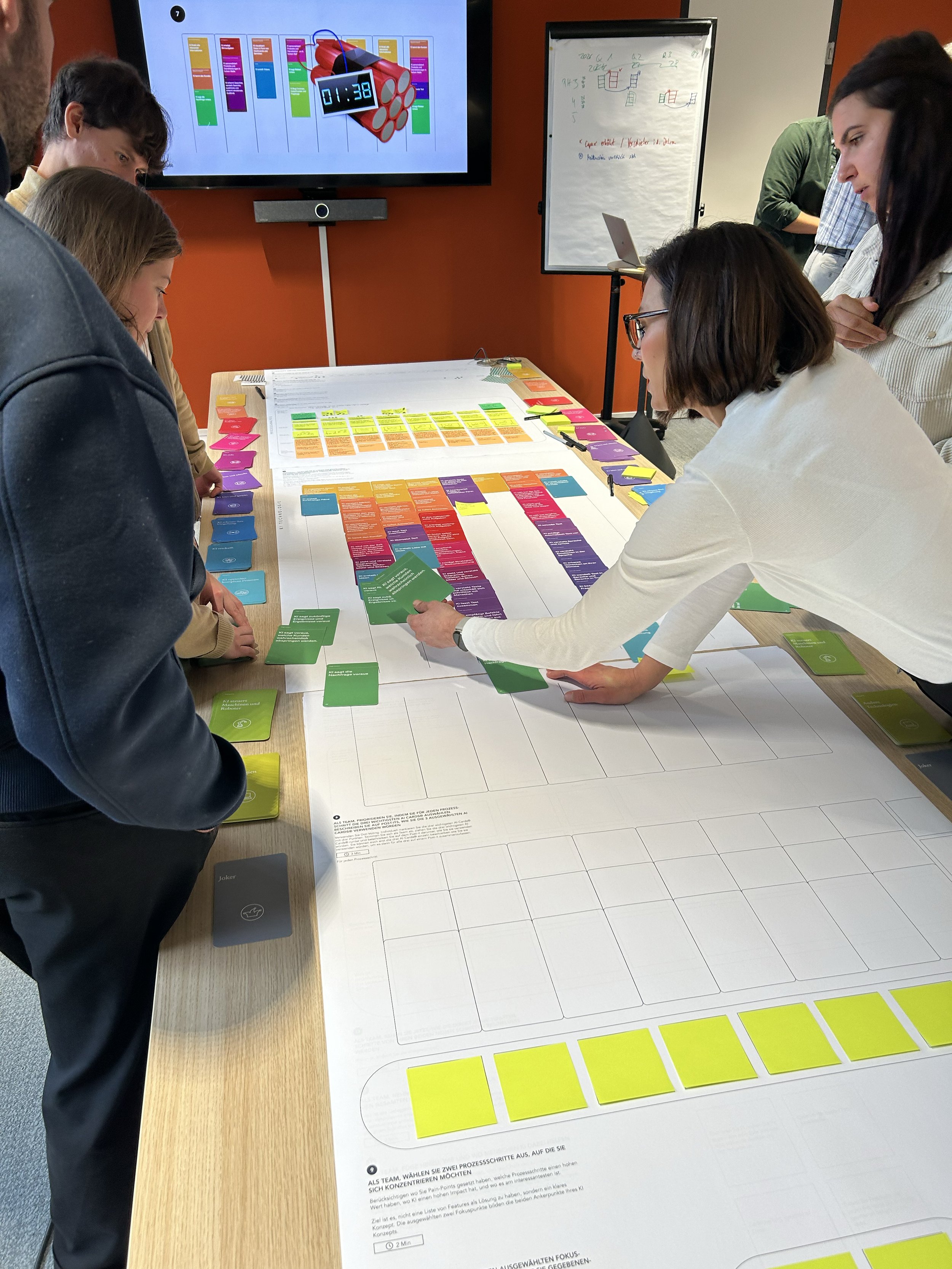
That's what our AI Cards® make possible. They organize the full landscape of AI capabilities, formulated not in technical terms but from the user's perspective — what AI can do for you. Anyone on the team can work through them, match them against their process, product, or problem, and spot opportunities that a pre-selected list would never surface.
When you start with everything, you end up with the best answer — not just an available one.
The sprint picks up the team wherever they are
In our experience, teams come to the AI Design Sprint® from one of two places.
Some are in the orientation phase — they sense AI could deliver value, but don't yet know where to focus or what direction to take. Others have already identified their focus: a specific process, product, or problem. They know the what, but not the how — how to shape the solution, what's technically possible, and how to get everyone aligned.
The AI Design Sprint® has a format for each.
Opportunity Mapping helps teams in the strategic phase make directional decisions and define their focus area. The input can be as broad as: we believe AI could create value here, but we don't know where to start. The output is that clarity — a specific process, product, or problem worth pursuing.
That focus area becomes the input for Concept Development & Assessment — where the team develops a detailed AI solution concept together. The output is a technical brief: a concrete, specific definition of the solution, ready to hand to a technical team.
And that's where the larger journey continues. With the technical brief, the technical team performs a feasibility check and builds a prototype. That prototype gets tested, refined, and eventually integrated as a running solution — monitored and adapted over time, because the world keeps changing.
Wherever your team is in that journey, there's a format to meet you there.
How it works
Training Structure
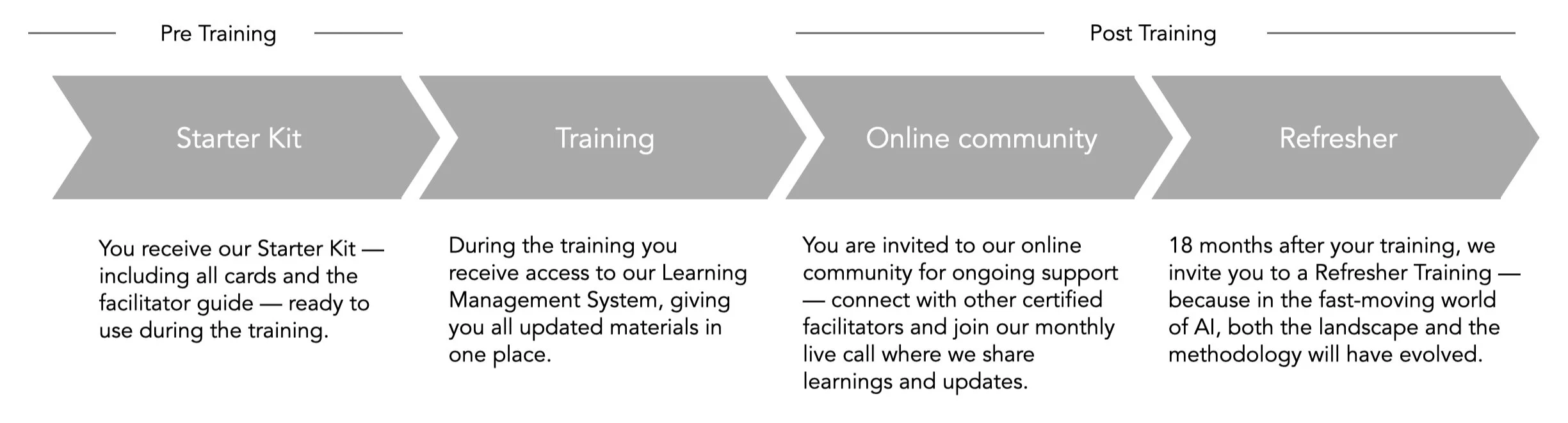
The training is divided into two halves. In the first half, you experience the full AI Design Sprint®: Process Automation — Opportunity Mapping and Concept Development & Assessment — from the participant's perspective. In the second half, you switch into the facilitator role. Facilitating parts of the Concept Development session yourself serves as a natural recap while putting you in the role you'll take on with your own clients or teams. You'll also work with the preparation templates and learn how to hand over to the technical team.
Training Agenda
Half-day 1 — Opportunity Mapping Participants work through an example case, identifying focus areas for AI application within a business area and department using the Opportunity Mapping format.
Half-day 2 — Concept Development & Assessment Taking the focus area identified in half-day 1, participants develop a detailed AI solution concept and assess it using the Concept Development & Assessment format.
Half-day 3 — Facilitation Practice Participants facilitate the Concept Development format themselves — recapping the methodology and stepping into the facilitator role as early as possible.
Half-day 4 — Preparation & Outlook Introduction to the preparation template and technical brief template. Outlook to Tech Check and Prototype, with time to address technical questions.
Trainer

Michael Brandt
CEO, Co-founder

Kerstin Bognar
Facilitation
Or two other trainer from 33A.
Presenting ‘Tech Check’ and ‘Prototype’

Joanna Stoffregen
AI Product Development

Erik Stoffregen
AI Product Development
Join the Company Team Training
Get in touch and we'll propose a date and format that works for your team.
Join the Bootcamp
Choose a date and secure your spot.
Already full
20.-23. Apr
14-18.00 (CET)
€1.800

25.-28. May
9-13.00 (CET)
€1.800

Can't make either date? Let us know you're interested and we'll notify you as soon as new dates are announced.
What to expect
This is not a sit-and-listen training. You work hands-on with the methodology from the start, and step into the facilitator role as quickly as possible — guiding parts of the session just as you would with a real client or in-house team. By the end, you've already practised leading it.



What others are saying
“It was a truly brilliant training for our team! I was already very impressed with your approach beforehand, and I am even more so after participating in the training. The AI Design Sprint® offers an excellent opportunity to bring business colleagues and technical experts together to speak the same language when it comes to AI.
It transforms challenges into specific, detailed solutions, and prioritizes impact over innovation for its own sake. This approach is perfect for us for driving AI adoption throughout our large organization.”
Ivo Strohhammer, Enterprise Architect, SI IT Innovation Lead, Siemens