

It’s so simple
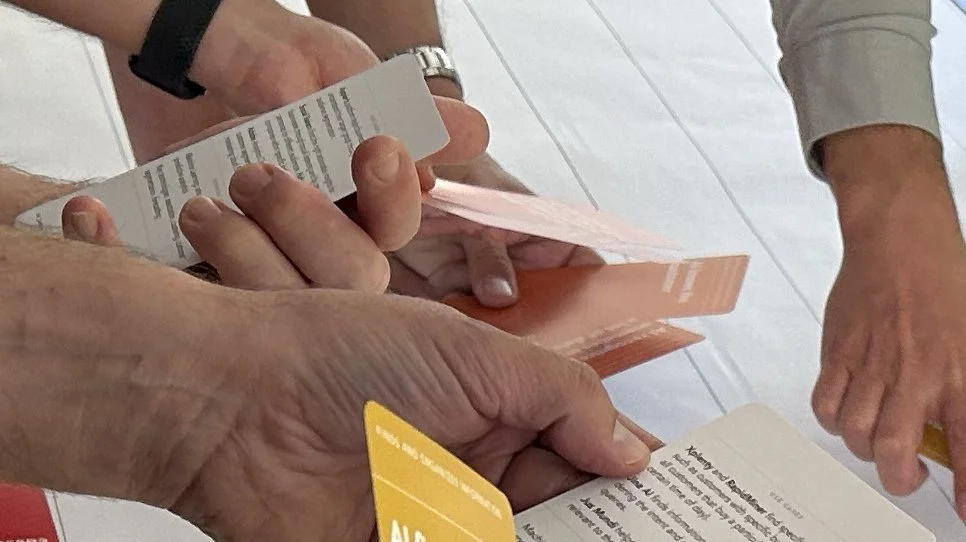

Get our cards
They come in paper and digital form. You’ll get them with the training. — They bring the knowledge in small pieces and in a language everyone understands to the team.

And our training
The training at the moment is remote live. A self-paced, hybrid training is launching soon. — Here you get super comfortable using the cards and the Collaboration Board.
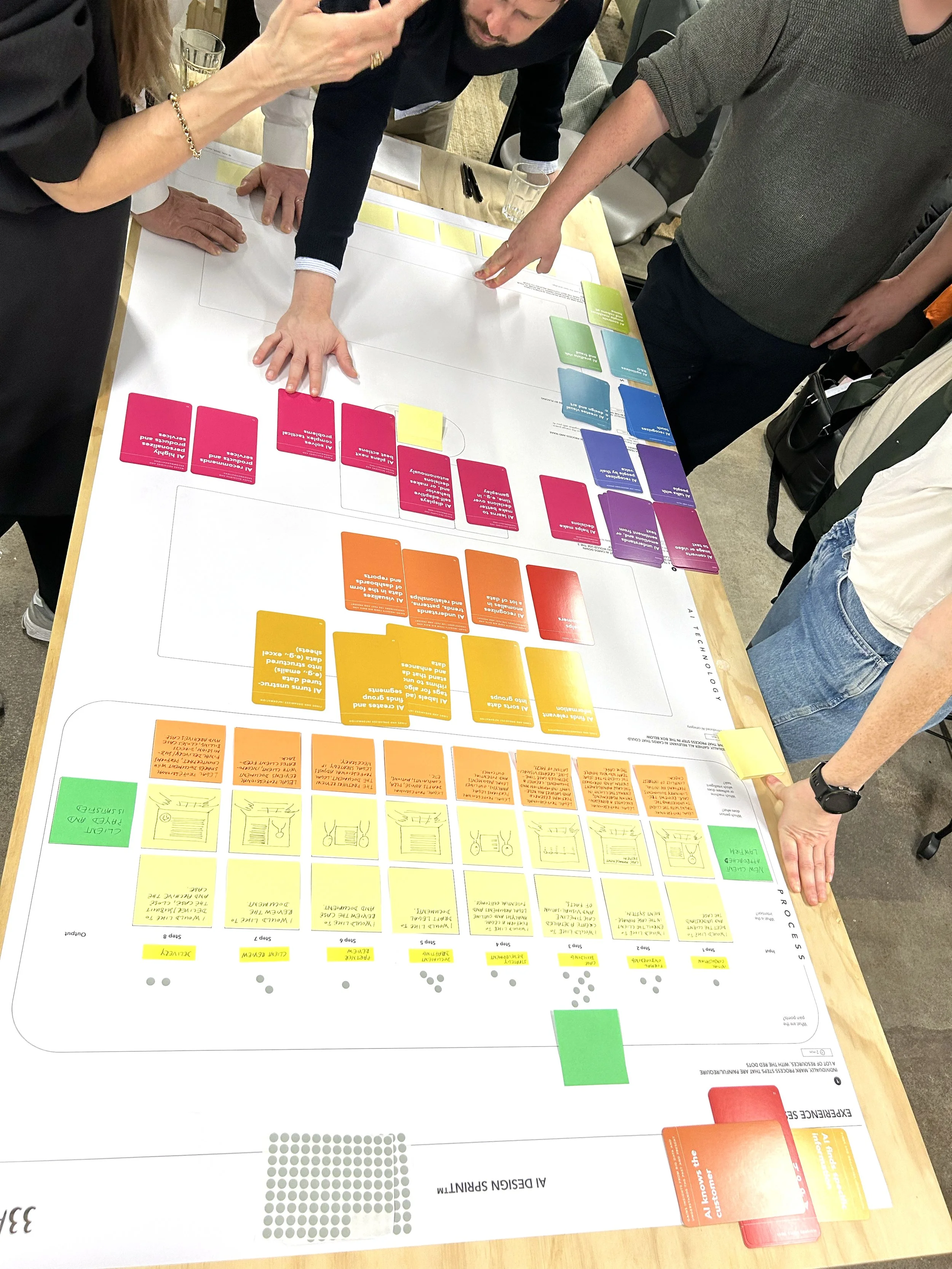

Get our Collaboration Board
In paper and digital form. Also here, you’ll get them with the training. — It guides the team step by step towards their solution.
Voila, as a team you are fully equipped to develop AI solutions for your department or business area.
Unpack. Learn. Sprint.
A proven method, refined in hundreds of AI Design Sprints® and used by thousands of teams, packaged so you can run it yourself.
The AI Design Sprint® — a proven method
More than 1,000 teams have been trained in the AI Design Sprint®, and organisations like Microsoft, Siemens, McKinsey and E.ON run it today.
It’s based on the classic Google Design Sprint, compressed. Where the original needs four or five days, a team completes its first AI solution concept in one day.
The difference is the focus. Everything in the sprint is built for AI: the AI Cards® give the team a shared vocabulary for what AI can do, and the Collaboration Board guides them step by step from challenge/”as-is'“ situation to solution concept. No AI expert in the room. No AI assistant. The team does the work itself.
Why not just prompt an AI assistant, or bring in an AI technical expert?
Because you need the right people in the room first: the business people who know where the value is, the process owners, and the people on the ground who'll actually use the solution. And you need to know what to prompt or what to ask in the first place.
That's what the cards and the Collaboration Board are for — developing AI solutions together. The AI assistant and the technical expert aren't cut out of that. They're part of it.
Why the cards and the Collaboration Board are so valuable
Prioritizing potential AI use cases
You've probably gathered a set of AI use cases, and now you're prioritizing them. Let me challenge the gathering first. Whether they came from your own colleagues or a consultant's shortlist, these are usually the obvious use cases. So take a step back and consider the full range of AI capabilities — that's what the AI Cards® are for.
Then there's how you prioritize. A short list of parameters usually decides it — but the ones that matter most often aren't on it. The Collaboration Board brings them in: goal setting, pain points, business value, the shape of the use case itself, the use case within the AI use case system, the level of automation, ethics, data, value to the user, and benefit versus cost.
Ownership
Ownership comes from involvement. The cards and the Board put leadership in charge of the direction, and the people who run the process in charge of shaping the solution — so they own it.
From "which AI tool?" to "where AI creates value for you"
Too often the conversation is about which AI tool to use. Instead of chasing the latest tool, the cards and the Collaboration Board move the conversation to where AI and its capabilities create the most business value for you, and to what you actually want it to do.
The flow
In 2 weeks from 0 to a prototype
For no 1 and 2 you use our cards and Collaboration Board, any team can do that, no tech expertise needed.

Opportunity Mapping
This is your one-day session where you set a focus of where to apply AI. Output is the focus area.

Concept Development
This one-day session is where your team develops the specific AI solution. Output is the technical brief.
You might involve your AI technical people also in 1 and 2. Here the steps following the developed concept by the team.

Tech Check
In 2 days an AI technical expert performs a technical feasibility check. Output is the technical roadmap and scope of the prototype.

Prototype
In 7 days the AI technical expert builds the prototype with real data.